
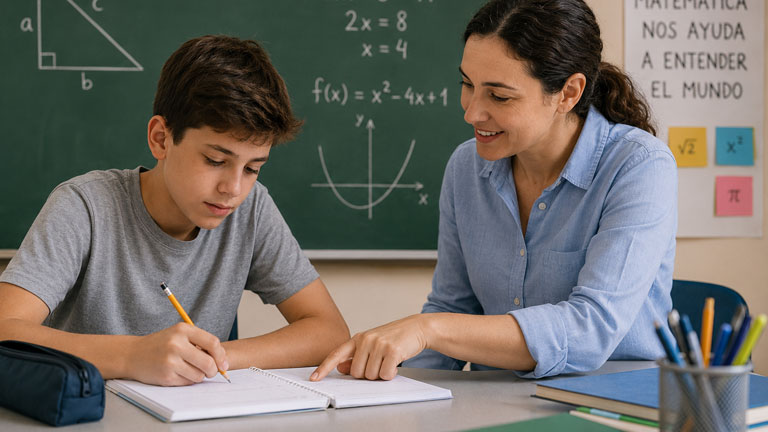
Reports on Mathematics Education
The document “Mathematics Education: Analysis and Proposals,” prepared by the National Academy of Engineering of Uruguay, addresses this issue based on a review of national and international sources and provides guidelines to help improve mathematics education in Uruguay.
This study complements the inter-academic report“Mathematics Education in Uruguay: Some Reflections,” expanding on the evidence considered and developing proposals in greater detail.
A complex problem with international implications
One of the report’s main contributions is to show that difficulties in mathematics are not unique to Uruguay. This is a challenge shared by many education systems and is linked, in part, to characteristics inherent to the discipline.
Mathematics deals with abstract concepts, and its various topics are closely interrelated. In many cases, to understand a new topic, students must have a solid grasp of the previous ones. When that foundation is not solid, students may have difficulty moving forward and reengaging in the learning process.
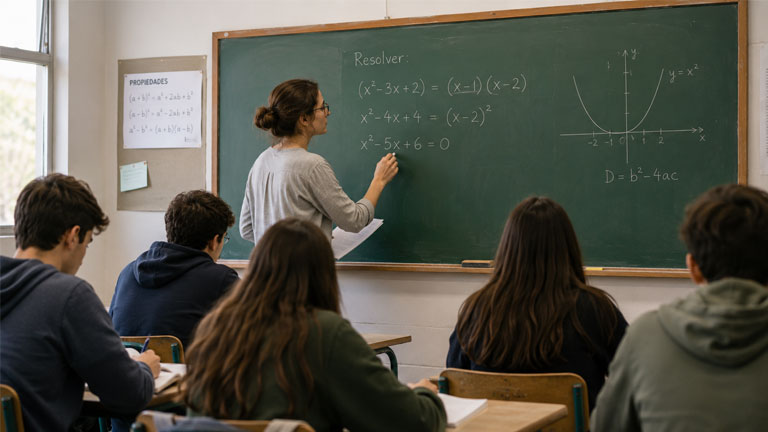
Added to this are other factors: the transition from arithmetic to algebra, the coexistence of different ways of representing the same idea, the precision of mathematical language, and the traditional emphasis on memorizing rules and procedures, sometimes without achieving a deep understanding of the concepts.
The document also highlights the influence of cultural attitudes and beliefs. The idea that some peopleare “good at math”and others are not can affect motivation and reinforce negative expectations from an early age. Families, teachers, and the social environment all play a role in shaping these perceptions.
Learning math is much more than just doing calculations
Mathematical proficiency is not limited to following procedures or arriving at the correct answer. The report outlines a broader concept that includes understanding concepts, fluency in procedures, the ability to formulate strategies, solve problems, adapt one’s reasoning, and maintain a productive attitude toward the subject.
From this perspective, learning mathematics involves developing tools to interpret information, evaluate quantitative situations, justify decisions, and solve problems in various contexts.
Mathematics also serves as a foundation for other disciplines and for numerous activities in everyday life. Mastery of mathematics is essential for science, technology, engineering, economics, and data analysis, but also for exercising informed citizenship in a society increasingly shaped by indicators, statistics, and quantitative models.
The Crucial Role of Teachers
The analysis identifies teachers as one of the most influential factors in the classroom. To teach mathematics, it is not enough to know the procedures: it is necessary to have a deep understanding of the concepts, to know how they relate to one another, and to anticipate the difficulties students may encounter.
It is also essential to be able to explain the same idea in different ways, use appropriate examples, interpret mistakes, and turn students’ responses into learning opportunities.
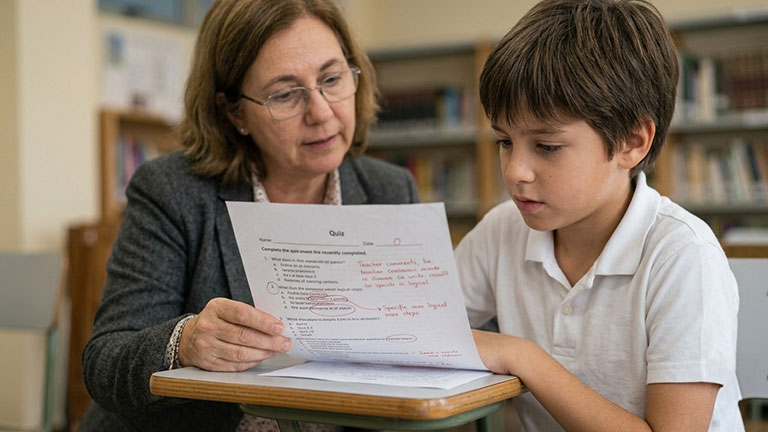
The report emphasizes that teachers’ mathematical knowledge must be accompanied by a specific understanding of how students learn. The training required to teach is not the same as that acquired in college courses designed for specialists or technical professionals.
Teachers must be able to “break down” abstract ideas, make them accessible, and connect them to different levels of representation.
In this regard, strengthening initial teacher training and ongoing professional development appears to be one of the lines of action with the greatest potential. The document proposes viewing teacher training as a lifelong process that enables teachers to reflect on their practices, collaborate with other teachers, and adjust their strategies based on evidence regarding student learning.
Teach students to reason, not just to repeat procedures
Teaching practices are central to the proposals. The report highlights the need to move away from classes focused primarily on repeating procedures toward experiences that promote problem-solving, reasoning, and the comparison of different methods.
Among the strategies mentioned are the use of problems based on real-life situations, working in pairs or small groups, assigning open-ended tasks, and collectively analyzing correct and incorrect solutions.
Mistakes should not be viewed solely as failures, but rather as opportunities to understand how students are reasoning and which areas they need to review. Explaining a procedure, justifying a decision, and comparing alternatives contribute to deeper learning than simply following a set of instructions.
The document also considers the use of physical objects and digital tools to represent abstract ideas, explore relationships, and visualize concepts. However, it cautions that technology should serve the educational objective and not become an additional obstacle or an end in itself.
A coherent and focused curriculum
Another proposed area of focus is the development of a curriculum that is consistent across different educational levels. Programs should focus on fundamental concepts, avoid being too broad, and ensure a clear progression over time.
Teaching materials should also be aligned with that sequence. In addition to presenting content and exercises, they should help teachers understand common mistakes, different ways of solving a problem, and the processes through which students grasp concepts.
The report notes that problem-solving should play a central role, because it allows students to connect content, develop strategies, and make sense of procedures.
Assess to Improve Learning
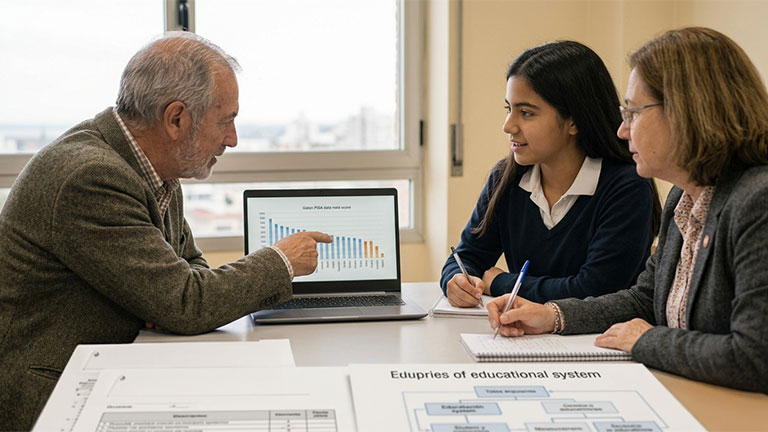
Standardized assessments, such as PISA and Aristas, provide relevant information on student performance and help identify gaps related to socioeconomic contexts, educational trajectories, and institutional characteristics.
However, the document cautions that a correlation between two factors does not necessarily imply a causal relationship. The results should be used with caution—as a basis for formulating hypotheses, guiding research, and designing policies—but not as an automatic explanation for complex phenomena.

In the classroom, assessment should go beyond the final grade. The report proposes strengthening formative assessments, which can provide useful information to students and teachers about the status of learning and the steps needed to move forward.
Assessment should not consist solely of checking whether a correct answer was obtained, but should also involve analyzing conceptual understanding, the strategies used, and the ability to justify an answer.
Context matters
The international survey shows that it is not advisable to automatically adopt practices that seem to work in other countries.
Educational systems are shaped by cultural, institutional, curricular, and social differences. A strategy that is effective in one setting may not produce the same results in another.
For this reason, the report proposes examining international experiences to identify useful principles, but adapting them thoughtfully to the needs and characteristics of the Uruguayan context. Comparisons between countries can offer relevant ideas and questions, but they do not constitute a ready-made recipe for improvement.
Start in Early Childhood
The document places special emphasis on early childhood and elementary education. It is during these stages that the conceptual foundations and attitudes that will shape future learning are established.
Early experiences with numbers, shapes, measurements, and spatial relationships can influence both students’ mathematical abilities and their confidence in the subject.
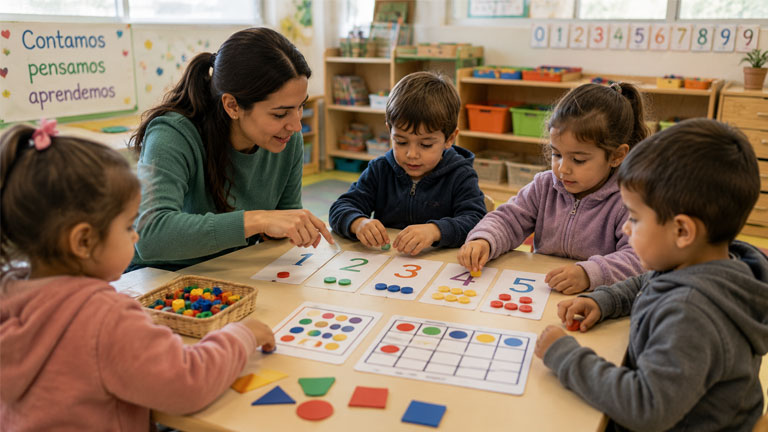
Strengthening the training of teachers who work at these levels, providing appropriate materials, and creating meaningful learning experiences are essential steps to prevent difficulties that, over time, become more difficult to address.
A sustained and coordinated strategy
Improvements in mathematics education cannot depend on isolated measures. The report highlights the need to coordinate the curriculum, instructional materials, teaching practices, assessment, teacher training, and the organization of educational institutions.
It also notes that decisions should be based on research and systematically evaluated to assess their effects.
This challenge requires sustained and coordinated action among policymakers, teacher-training institutions, schools, teachers, and families. It is not merely a matter of improving performance in a single subject, but of strengthening essential skills for education, social participation, and the country’s future development.

